
Put a Dexter steak in a blind taste test against Angus, Wagyu, and other celebrated breeds — and it keeps winning. Country Life magazine did exactly that with a panel of professional tasters and named Dexter the outright champion. The American Royal Association held a grass-fed beef competition judged by Kansas State University, and an Irish Dexter finished near the very top of the rankings. Gordon Ramsay has featured Dexters on his TV show and his Michelin-starred restaurant Pétrus has put Dexter short rib on the menu. This isn't a coincidence. There's a real reason this ancient Irish breed produces some of the finest beef in the world — and it starts at the cellular level.
What Actually Makes Dexter Beef Different
Spider-Web Marbling
Dexter cattle develop a distinctive fine "spider-web" intramuscular fat pattern — distributed evenly through the muscle rather than in thick seams. This marbling melts during cooking, basting the meat from the inside and delivering juiciness without greasiness.
Fine Muscle Fibers
Dexters have naturally smaller, denser muscle fibers than larger commercial breeds. Smaller fibers mean a finer grain, which translates directly to tenderness you can feel in every bite — no tenderizing, no marinating required.
Nutritional Profile
Grass-fed Dexter beef is measurably higher in Omega-3 fatty acids, Omega-6, Omega-9, and conjugated linoleic acid (CLA) compared to commodity grain-finished beef. Better fat, better flavor, better nutrition — all three at once.
The flavor itself is hard to describe until you've tasted it. Dexter producers and chefs consistently reach for the same words: "big beef flavor," "rich umami," "slightly sweet," "tastes like beef used to taste." That last phrase points to something real. Modern commercial cattle are bred for growth speed and yield — not flavor. Dexters were never bred that way. Over centuries on Irish hillsides, they developed genetics optimized for something else entirely: thriving on poor pasture and converting grass into extraordinarily flavorful meat.
The result is a beef that delivers intense, complex flavor without excessive fat. Compared to Wagyu, it's less fatty but more nuanced. Compared to Angus, it's richer and more characterful. Several butchers note that because the Dexter carcass is smaller, the same steak weight produces a naturally thicker cut — and a thicker steak is easier to cook perfectly, giving you time to build a deep crust without overshooting your target temperature.

Dexter rib-eye showing the characteristic fine "spider-web" marbling pattern — intramuscular fat distributed evenly throughout the muscle.
The Country Life Blind Taste Test: Dexter Wins
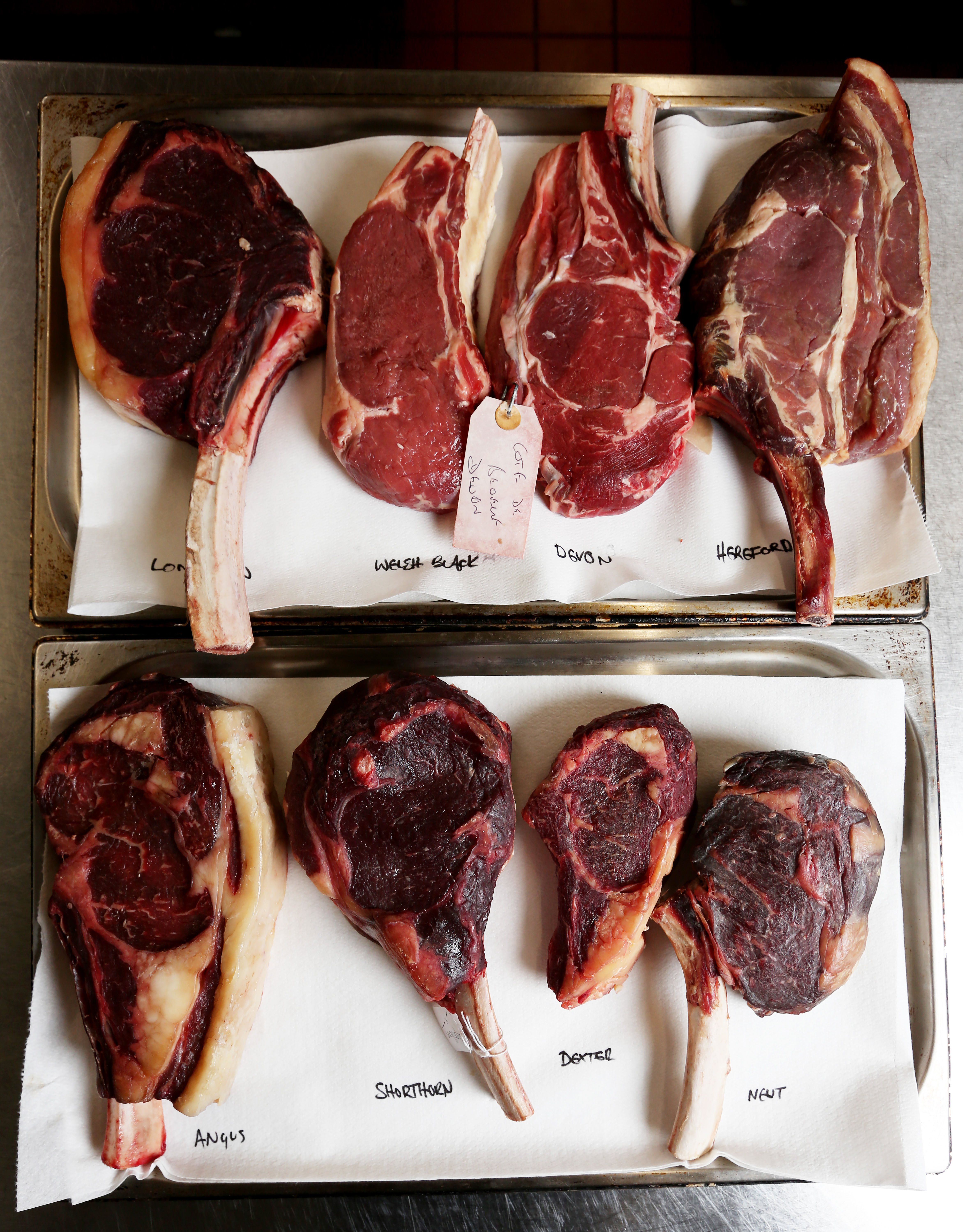
Country Life magazine — one of Britain's most respected publications on rural affairs and food — set out to answer a simple question: which native British and Irish breed produces the best beef? They assembled a panel of professional tasters, sourced beef from multiple heritage breeds, and ran a proper blind taste test where no one knew what breed they were eating. Dexter beef was the outright winner.
The Verdict
In Country Life's comprehensive tasting, Dexter beat every other breed entered — including Angus and other celebrated native varieties. The tasting panel praised the depth of flavor, tenderness, and the quality of marbling. You can read the full feature at countrylife.co.uk .
What's notable about a blind taste test is that no one's enthusiasm for the breed or its heritage can influence the result. The beef either tastes better or it doesn't. When Dexter keeps winning these tests, it's the meat doing the talking.
American Royal / Kansas State University: Irish Dexter Near the Top
The wins aren't limited to the UK. At the American Royal Association Grass-Fed Beef Competition — judged by Kansas State University — an Irish Dexter entry from Missouri finished among the very highest-ranked entries out of dozens of competitors. The cattle were scored on overall flavor, tenderness, initial juiciness, sustained juiciness, sustained flavor, and flavor finish. Dexter stood up against Angus cross, Wagyu cross, Murray Grey, Beefalo, and other breeds. The results speak for themselves.

American Royal Association / Kansas State University Grass-Fed Beef Competition scoring — Irish Dexter ranked among the top entries, outscoring Angus, Wagyu cross, Murray Grey, and Beefalo.
Gordon Ramsay and the Dexter Connection
On his TV show The F Word, Gordon Ramsay had journalist Janet Street-Porter raise Dexter cattle specifically to supply his restaurant kitchen. Ramsay introduced the breed to viewers as a "miniature Irish breed" selected to produce "top-notch beef." His Michelin-starred London restaurant Pétrus has featured Dexter short rib of beef on the menu — a deliberate choice by one of the world's most exacting kitchens. When a chef of that caliber selects a specific breed for his restaurant, it says everything about the quality on the plate.
Michelin-starred chefs don't put a breed name on the menu unless it genuinely makes the dish better. Sourcing Dexter specifically — rather than simply buying premium beef from a commodity supplier — reflects how distinctly different the eating quality is. The flavor is identifiable. It's that good.
The Grass-Fed Advantage
Dexter cattle are uniquely suited to a 100% grass diet. Their heritage as a breed that thrived on rough Irish pasture means they convert grass efficiently and finish well without grain. This matters for flavor: grass-finished beef has a more complex, slightly nutty, "old-fashioned" taste compared to grain-finished beef, which tends to be milder and more uniform.
The nutritional difference is measurable. Grass-fed beef consistently shows higher Omega-3 content, higher CLA, and higher fat-soluble vitamins compared to grain-finished counterparts. You're not just eating better-tasting beef — you're eating beef with a better fat composition.
Grass-Fed Dexter
- ✓ Complex, sweet, earthy flavor
- ✓ Higher Omega-3 fatty acids
- ✓ Higher CLA content
- ✓ Spider-web marbling throughout
- ✓ No added hormones or grain
Commodity Grain-Finished Beef
- – Mild, uniform flavor
- – Lower Omega-3 ratio
- – Lower CLA
- – External fat rather than marbling
- – Often finished on corn and soy
Taste It for Yourself
We raise Dexter cattle on open pasture at Marpe Farm in Cameron, Texas. 100% grass-fed, raised the old-fashioned way. When beef is available, we sell direct.
Shop Dexter BeefCommon Questions
How does Dexter beef compare to Wagyu?
Both are celebrated for marbling, but they eat very differently. Wagyu has extremely high intramuscular fat — almost buttery — which some people find too rich. Dexter beef delivers a bold, complex flavor with 'spider-web' marbling that keeps it juicy without the greasiness. Many tasters, including judges in blind tests, actually prefer Dexter for its depth of flavor.
Does grass-fed Dexter beef taste different from grain-finished?
Yes. Grass-fed Dexter has a more complex, slightly sweet, earthy flavor — often described as 'beef the way it used to taste.' The higher Omega-3 and CLA content from a grass diet also adds subtle nuttiness and a cleaner finish. Grain-finished beef is milder and more uniform, but lacks the flavor nuance.
Why are the steaks thicker from a Dexter?
Dexters are a small breed — cows typically weigh 600–700 lbs at harvest. Because the animal is smaller, a standard steak weight (e.g., 12 oz) comes from a smaller-diameter muscle, so the slice is naturally thicker. A thicker steak is actually a cooking advantage: you can develop a deep crust on the outside while keeping the center a perfect rare-to-medium rare.
Is Dexter beef healthier than regular beef?
Grass-fed Dexter beef contains significantly higher levels of Omega-3 fatty acids, conjugated linoleic acid (CLA), and Vitamin E compared to commodity grain-finished beef. CLA in particular has been studied for potential benefits related to body composition and immune function. It's not a health food in the traditional sense — it's beef — but it is a nutritionally richer version of it.
Where can I buy Dexter beef?
Small farms like ours raise Dexter cattle specifically for the table. We raise our Dexters on open pasture in Cameron, Texas, and sell directly to customers who want to know exactly where their beef came from. Check our website for current availability.
How should I cook a Dexter steak?
Treat it like premium beef: season simply with salt and let the flavor do the work. Because the muscle fibers are fine and the marbling is well-distributed, Dexter steaks cook quickly and are very forgiving. A cast iron sear with butter, garlic, and fresh thyme — finished in the oven for thicker cuts — is hard to beat. Avoid overcooking: medium-rare to medium preserves all the juiciness.